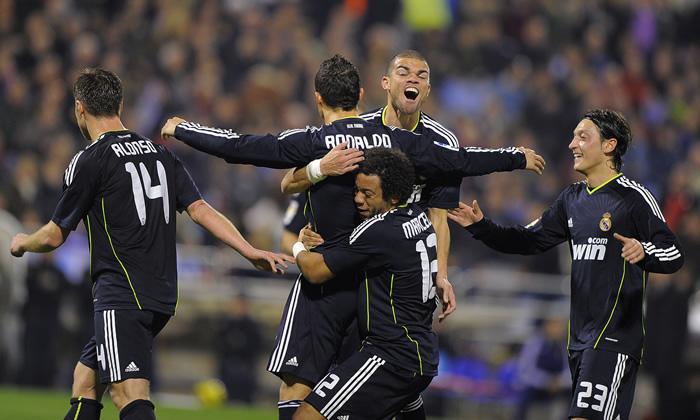
El Zaragoza demostró su condición de colista ante un Madrid espoleado por la que había liado Mourinho en la víspera con lo de los perros y los gatos. Özil, Cristiano y Di María firmaron el 1-3 que mantiene al 'Moudrid' en la lucha. ¡Guauuu!


Victoria animal. Mourinho nos metió en el terreno de Faunia con su parábola de los perros y los gatos, hasta el punto de que el partido de La Romareda fue un concierto de comparaciones más o menos chistosas. Que si Benzema es un lindo gatito, Cristiano Ronaldo y Di María dos pitbull, Lass un esbelto dálmata, Özil un pastor alemán, Pepe y Carvalho gatos siameses, Xabi Alonso un husky siberiano, Marcelo un chihuahua, Arbeloa un lobo y Casillas un doberman con guantes. No vino mal que Mourinho sacudiese la atmósfera previa al partido con su rajadita de la víspera, porque su equipo salió enchufado desde el minuto 1. El Zaragoza de Aguirre duró menos que un donut a la puerta de un colegio. Lo que no me gustó es que Mourinho reculase en la conferencia de prensa desviando el divertido asunto de los perros y gatos hacia los sistemas tácticos. Míster, si la afición que vio su disertación por Realmadrid TV y la totalidad de los medios coinciden en la interpretación de sus palabras, no será una cuestión de falta de inteligencia. Además, estuvo usted ocurrente. No deje que nadie le caliente la cabeza...

El 'tigre' Cristiano. Me cuentan que las personas que quieren bien al megacrack portugués le llaman tigrao (tigre en castellano). Bien puesto el apodo. Este futbolista es mucho más que un perro o un gato. Es un tigre de Bengala. Se sobrepone a los insultos a coro y responde a las patadas que le propinan con calidad, goles y espectáculo. Ayer nos regaló un taconazo de genio que abrió la goleada (magnífico Marcelo en el desarrollo y Özil en la ejecución) y un tomahawk en 3D. Cristiano va a hacer historia en el fútbol español y me gustó la defensa que de él hizo anoche Mourinho. El 7 debe ser considerado patrimonio de la Liga BBVA y no entiendo ese ensañamiento con alguien que mejora la puesta en escena de este deporte hasta justificar el alto precio de las entradas. Cristiano, tú tranquilo máquina. El madridismo jamás te dejará caminar solo...

¡Vaya arbitraje! Llueve sobre mojado en el reino del Villarato. Da igual que sea ante el colista. Ramírez Domínguez escamoteó al Madrid dos penaltis de libro (uno sobre Lass y otro en un tiro libre de Cristiano). Les doy un dato. En los tres últimos partidos, a los blancos les han birlado cuatro penaltis. Los dos reseñados más el de Cristiano en el Camp Nou y el de Miguel a Di María ante el Valencia. Y con las tarjetas se ensañó. Fue a por Marcelo desde el pitido inicial e hizo un reparto cutrísimo.

Liga Bipolar. Hasta el 16 de abril, fecha del Clásico del Bernabéu, esto no va a cambiar. El Zaragoza no pudo frenar a este equipo demoledor que ha recuperado la pegada. Y el sentido común. Lass salió por la puerta grande. Enorme el pequeño francés. Jugón. Con Xabi Alonso, pareja perfecta. Ya llueve menos. Hay Liga señores.

Tomás Roncero


As the weight of their potentially crippling debt sinks in, Barcelona have signed a five-year, €150 million ($200 million) deal with the non-profit Qatar Foundation for shared space with UNICEF as the club's shirt sponsors. UNICEF became the club's first ever shirt sponsor in 2006, but Barcelona contributes €1.5 million annually to the organization as part of the deal. This deal with the Qatar Foundation marks the first time in the club's 111-year history that it has been paid to advertise on their shirts.

Barcelona said the UNICEF name will remain on the shirts and that it would seek a way to combine the two logos, but the Qatar Foundation would be the prevalent one if a solution cannot be found.
The club said the deal could be worth up to 170 million euro ($225 million) with add-ons.
“With this deal, Barcelona places itself as the indisputable brand leader in world football ahead of our international competitors,” Barcelona’s financial vice president Javier Faus said Friday.
Barcelona previously flirted with deals but this marks the first time in the Catalan team’s 111-year history it will be paid to advertise.

Barcelona will receive €30 million per season, topping previous record holders Manchester United and Liverpool by a wide margin.

What's odd about this deal is that the Qatar Foundation for Education, Science, and Community Development is a private organization with aims at improving those fields within the borders of the state. It was started by the Emir of Qatar in 1995 and Sheikha Mozah bint Nasser Al Missned, one of the few women to take part in the bidding process for the 2018 and 2022 World Cups, serves as chairperson. Given the nature of the foundation (as opposed to the international cause of UNICEF), it's hard not to wonder how sponsoring a Spanish football club will help its stated cause or why it wouldn't be more beneficial to just pump that €150-170 million directly into the foundation.
Coincidentally, Barca manager Pep Guardiola was a paid ambassador for Qatar's successful 2022 World Cup bid, while club president Sandro Rosell has been a vocal proponent of the development of a Qatari football academy styled after Barcelona's.

Amidst rampant speculation over possible backroom deals, whether Qatar is capable of hosting, and the environmental impact of its plan, there are bound to be conspiracy theories that follow this announcement. But regardless of that, Barcelona once again proved they're "more than a club." Like everyone else with a shirt sponsor, they're also now a propaganda tool.


I had the honor of being invited by Elisa Uranga to join her & Mando Garcia at the Forza Futbol Virtual Spanish pub, along with two Cules: Steven Kuzner of the World Football Daily Blog and Nolan Berlin to discuss post-clásico blues.


Whatever your opinion of Major League Soccer, almost everyone will agree the league is no cash cow. Far from it.

So why would the relatively frugal MLS happily fork over $2 million to the USA Bid Committee, the lead element in a chase to deliver World Cup 2022 to this country? Why would MLS donate such a handsome sum this late in the game, when things already look so promising ahead of Thursday's massive announcement?

Because everyone associated with MLS knows exactly what's at stake. They recognize the spectacular growth opportunities World Cup 2022 could create for the league and domestic soccer in general. So grand are the stakes, so golden the rewards, that MLS commissioner Don Garber and the league owners were happy to toss more cash into the kitty to fill any remaining gaps.

For months now Garber and U.S. Soccer president Sunil Gulati, who also chairs the USA Bid Committee, have been talking about the unprecedented 12-year runway, the dozen potentially fruitful years between Thursday's announcement and World Cup 2022. Talk about a landmark period of leverage for domestic soccer. That's all assuming that the U.S. bid can trump efforts from Australia, Japan, Qatar and South Korea in a process already dented by corruption.

"If we do prevail, then between now and 2022 we will have a 12-year run that will change this league and the sport in America forever," Garber said last week.

Garber is confident that it can happen. Qatar has oodles of money behind its bid, but has significant weather challenges -- it's prohibitively hot. Australia has an outside shot, although China's emergence as a potential 2026 host could complicate the Aussie bid. Same for Japan and South Korea, countries further challenged by another impediment, having hosted a World Cup even more recently than the United States.

Garber met with a small group of reporters and bloggers one day before the MLS Cup final in Toronto. While the commissioner didn't talk about specific opportunities for his league -- now an 18-team operation but one still seeking aggressive growth-- it's not hard to decode his messages.

Bill Clinton: Why the U.S. is a perfect match for 2022

Outside of the obvious, the boon to development of fans and players, it's mostly about leverage. Imagine Garber and Gulati (in his role as U.S. Soccer president) going to the networks for contract talks. Consider their favorable place at the bargaining table as they bundled MLS and national team matches with World Cup rights. It would add instant value to MLS contests, to World Cup qualifiers, to Women's World Cup rights, etc. Suddenly, elements that might not have been on the table previously (such as a more favorable slot for the MLS Cup final, just to name one) could be in play as networks keen on securing World Cup rights become more agreeable.

At the local level, a city with designs on those World Cup delights will need to develop a regional plan to promote and enhance the sport. As many as eight of the 18 U.S. cities currently under consideration will not make the cut, so they'll need to improve their odds by pandering a little to MLS or to U.S. Soccer. The league could leverage it all kinds of ways, by attracting higher franchise fees for newcomers or by requesting tax breaks for stadiums in existing markets, for instance. Or it might mean the development of a blue-ribbon training site, which a close-by MLS side would use around the small World Cup window.

It all feeds into a lucrative growth cycle. Leveraging these opportunities will create more favorable financial situations. That provides more cash for player acquisition and marketing opportunities to increase awareness of the stars yet to arrive in MLS. Presumably, these stars and the increased quality they create will lure more people to the stadiums, which will add more money and more sponsors to propagate the cycle.

MLS could do all this without a World Cup acting as a huge fulcrum -- but the pace of the process would look very different. If the current pace is "X," a World Cup 2022 boost could speed up the pace of development to 3X or 4X.

Beyond MLS, Gulati has long stressed the infrastructure element of the U.S. bid. Specifically, a land blessed with an embarrassment of venue riches won't have to spend for facilities or the supporting, physical components. Rather, they can use development money to enhance the game itself through after-school programs, creation of inner-city fields, promotion of the women's game, etc.

Garber and Gulati say they speak to one another almost every day. Both say they share a vision of what soccer could look like here -- and so much of that vision revolves around a successful outcome Thursday in Zurich.

"That vision has the league as a focal point," Garber said recently as he toured MLS cities in the run-up to MLS Cup. "Because nobody disagrees with the fact ... that if we want soccer to succeed, Major League Soccer needs to get better. We need to have better quality. Need to have better facilities. We need better training grounds, need to have better player development, higher quality environments for players to compete in. We need to have more games and better games on television and all those things. So a lot of our attention is focused on our World Cup Bid."

Consider that the tremendous legacy of the 1994 World Cup was in establishing the sport in this country, about positioning soccer so that it could be mentioned alongside the bedrock sports in American culture.

It established MLS, the starting point for soccer to be taken seriously here past youth level. It provided the infrastructure and proper backdrop for a very successful Women's World Cup in 1999, a breakthrough moment in America's recognition of the sport. In the big picture, it moved the sport past an unattractive sticking point; soccer had previously been fastened to outlier status, that funny foreign game most people played in elementary school and then grew out of.

The 1994 World Cup established soccer as Americana, as a piece of the fabric of American life. Now, the legacy of World Cup 2022 here would be about digging down into the nitty-gritty, about cooking up ways to make the game better.

"The legacy, the upside of a market in a country like the United States, to be more engaged in the world's game, is something that is unique and extraordinary," Gulati said last week in Toronto. "One of our goals is to go from 100 million who watch the World Cup to 200 million. There aren't many countries who are bidding that can do that. Size matters."

POTENTIAL U.S. CITIES

The 18 U.S. bid cities for the 2022 World Cup, a list that will be culled to 10-12 as plans are finalized in years to come:

Atlanta
Baltimore
Boston
Dallas
Denver
Houston
Indianapolis
Kansas City
Los Angeles
Miami
Nashville
New York
Philadelphia
Phoenix-Glendale
San Diego
Seattle
Tampa
Washington, D.C.



El Larguero (3ª Parte/ 28-11-10)


El canal estadounidense ESPN, líder mundial en deportes, está preparando un gran despliegue para el Clásico Barcelona-Real Madrid del próximo lunes. De hecho, la productora española Asimétrica ha preparado una 'promo' especial que se puede ver en la pantalla gigante de Times Square, centro neurálgico de Nueva York.


La promoción es espectacular y se emitirá durante los próximos días tanto en Estados Unidos como Latinoamericana pues ESPN tiene diversos canales, tanto en inglés como en español y portugués.

Sin duda, un gran trabajo de nuestros compañeros que sirve para dar aún más lustre al duelo futbolístico más atractivo del planeta, que con iniciativas como ésta llega ya a cualquier rincón de la Tierra.


Up 4-0 over Ajax on Tuesday and with advancement to the knockout stage all sealed up, Jose Mourinho and Real Madrid got a little sneaky in their yellow card management.

First, Xabi Alonso earned his second yellow card and was sent off in the 87th minute after wasting time on a free kick in a way that looked like some kind of running seizure (video above). Then, in the 90th minute, Sergio Ramos earned his second yellow and got sent off when he took his sweet time on a goal kick (video below). That rules both players out for Real's final, utterly meaningless group stage match against Auxerre and gives them a clean slate for the knockout rounds.

Though they would never admit that they did this deliberately, you'd have to still believe in Peter Pan to believe that they didn't. To some people -- Champions League commentators included -- this is an outrage and to others it's just another example of Jose Mourinho's genius. After the match, Mourinho had this to say (via the AP):

“I don’t think it was necessary to get those red cards because we were in control,” Mourinho said. “But this is a fantastic result and that’s the only thing that matters.”


Marca thinks Jose used backup goalkeeper Jerzy Dudek in a game of whisper down the lane to pull this off.


UPDATE II: Well, it seems these guys weren't sneaky enough. UEFA has now charged Mourinho, Ramos, Alonso, and even Casillas and Dudek with "unsporting conduct." Their cases will be heard on November 30.